research
How do evolutionary processes mediate ecological patterns?
How do evolutionary processes mediate ecological patterns? How do changes in allele frequency, through time and across space, shape the abundance and distribution of organisms?
gene flow, mutation
population growth
range limits, persistence
Changes in allele frequency ripple through demography to shape the distribution, abundance, and persistence of populations, and ecology feeds back on evolution in turn. We follow this chain in both directions, across space and time.
We come at these questions with whatever tools fit them best: theory and simulation, long-term field data, experiments in nature, and experimental evolution in the lab. No single approach sees the whole picture, so we use several together. We're also not wedded to any one organism: if the processes we study are general, they should hold across very different systems, so we work across plants, insects, and microbes.
When can populations adapt to a changing environment?
The genetics of adaptation: standing variation, genetic architecture, gene flow, and how quickly evolution can track shifting selection.
Projects — click to expand for details & papers
Clarkia in space and time Population genomics of contemporary adaptation across a species' range
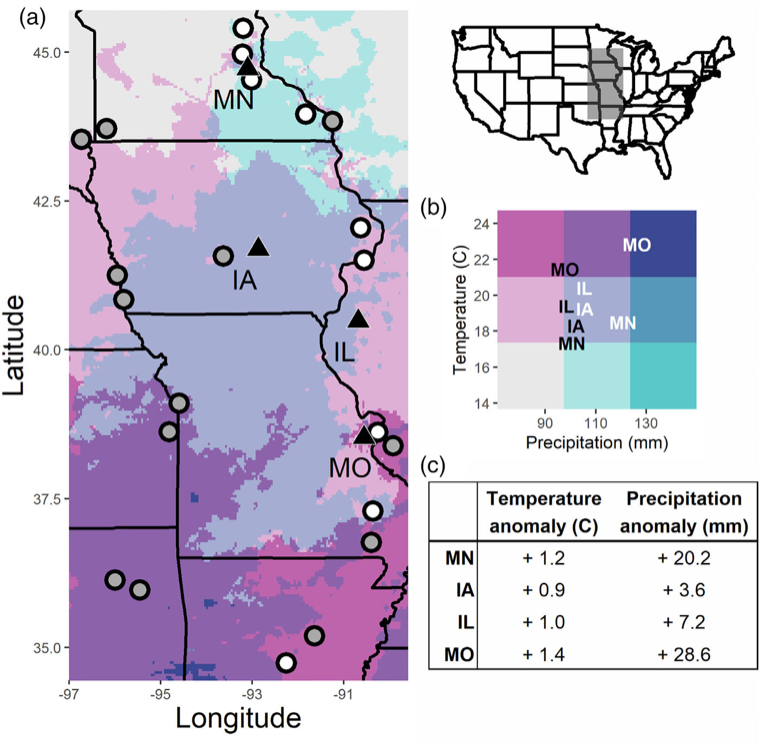
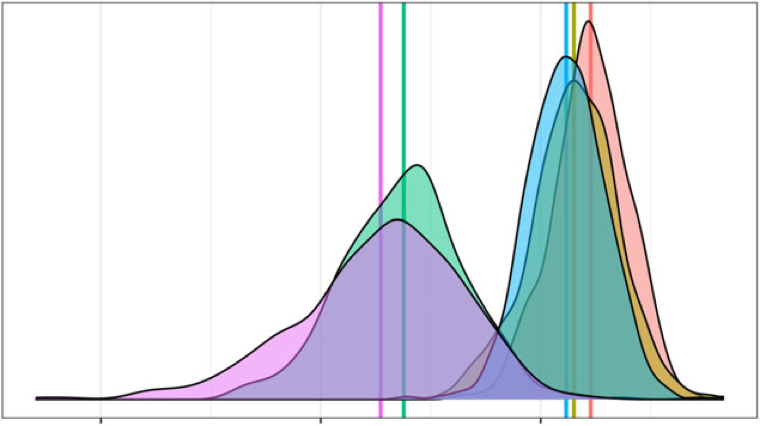
We’re using pool-seq across ~100 populations of Clarkia xantiana — sampled both historically and contemporaneously — to ask how allele frequencies have shifted over recent decades of climate change, and whether the same loci respond to climate across populations and across time. The work leverages long-term demographic and herbarium records from the Moeller and Geber labs, together with newly assembled reference genomes (see Clarkia reference genomes).
With Dave Moeller (Minnesota), Monica Geber (Cornell), and Jacob Landis (Cornell).
Key publications
The genetic architecture of adaptation in Clarkia Line-cross experiments to dissect the architecture of fitness differences across populations
Using crosses between populations of Clarkia xantiana that span the species’ range, we’re decomposing fitness differences into their additive, dominance, and epistatic components, then linking these to the genetic basis of local adaptation. The work tests classical predictions about how the architecture of adaptation shapes the predictability — and reversibility — of evolutionary response to environmental change.
Gene flow at a range edge A field experiment testing whether gene flow rescues or swamps marginal populations
At the edge of a species’ range, gene flow from the range core can either fuel adaptation by importing useful variation or swamp it by overwhelming local selection. Using experimental crosses between core and edge populations of Clarkia xantiana, transplanted back into the range margin, we’re directly measuring the fitness consequences of admixture across the species’ range — and asking whether gene flow helps or hurts populations facing novel conditions.
With Jacob Landis (Cornell).
What lets populations persist through time?
Long-term demography paired with genomics: which populations grow, decline, or hold on, and what drives those trajectories.
Projects — click to expand for details & papers
Long-term Clarkia demography Two decades of population dynamics across the Clarkia xantiana range
Long-term demographic data from ~20 populations of Clarkia xantiana — collected across two decades by the Moeller and Geber labs — let us ask how population dynamics vary across a species’ range, how the range edge differs from the core, and whether demographic and genetic signals of stress co-localize. We’re integrating these data with new genomic resequencing to bridge demography and evolution at landscape scale.
With Dave Moeller (Minnesota) and Monica Geber (Cornell).
Demography and genomics of fringed gentian Why is a once-common wildflower disappearing across the northeastern US?
The fringed gentian (Gentianopsis crinita) is a charismatic late-summer wildflower of eastern North American wet meadows — and it’s quietly disappearing. We’re pairing long-term demographic monitoring across populations with whole-genome resequencing and a common-garden experiment to ask whether decline is driven by demographic stochasticity, loss of genetic variation, mismatch with a shifting climate, or some combination. A reference genome and population resequencing are underway.
With Anurag Agrawal (Cornell) and Jacob Landis (Cornell).
What sets the limits of a species' range?
How biotic interactions, dispersal, and environmental gradients govern where species can live and how fast they spread into new terrain.
Projects — click to expand for details & papers
Biotic interactions and range limits How herbivory, mutualism, and soil microbes shape where a plant can persist
A species’ geographic distribution is an ecological pattern that emerges largely from the evolutionary process of adaptation, with the limits of that distribution often marking the boundary between adaptation and maladaptation. But most species live across complex gradients in which many biotic and abiotic conditions change together, so it is rarely obvious which factors actually set the edge of a range.
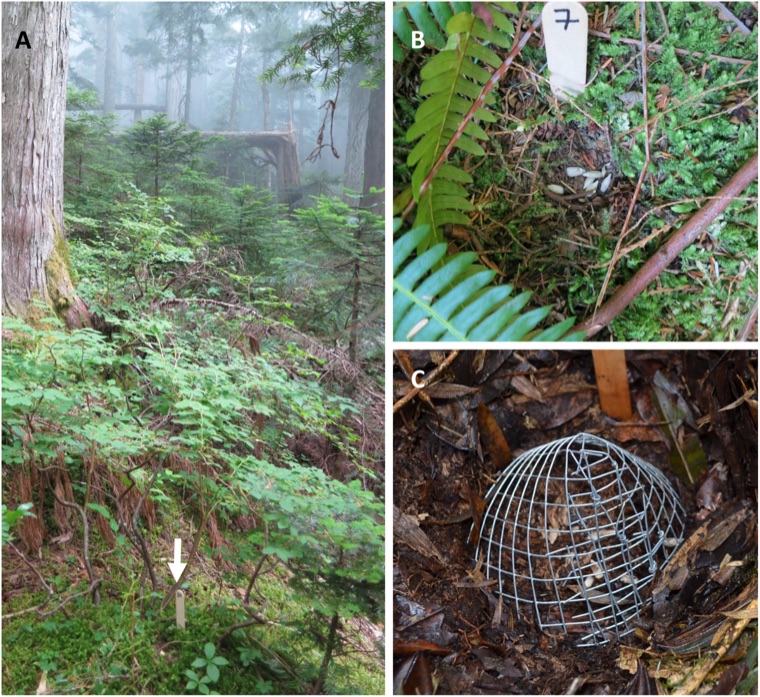
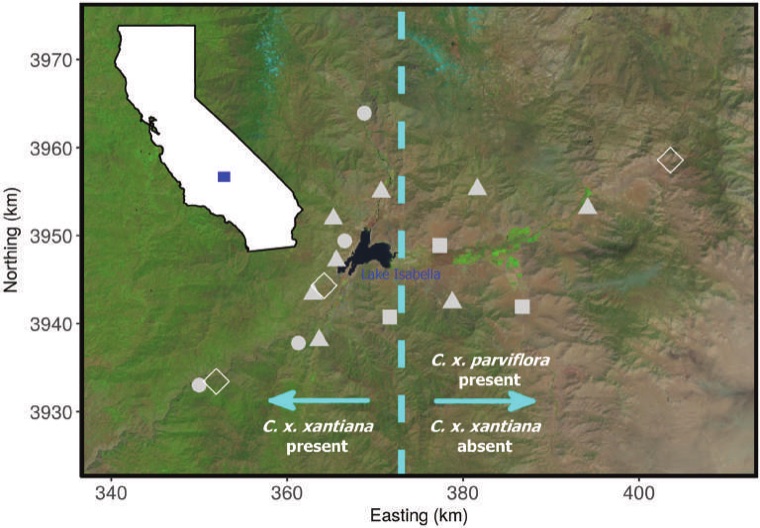
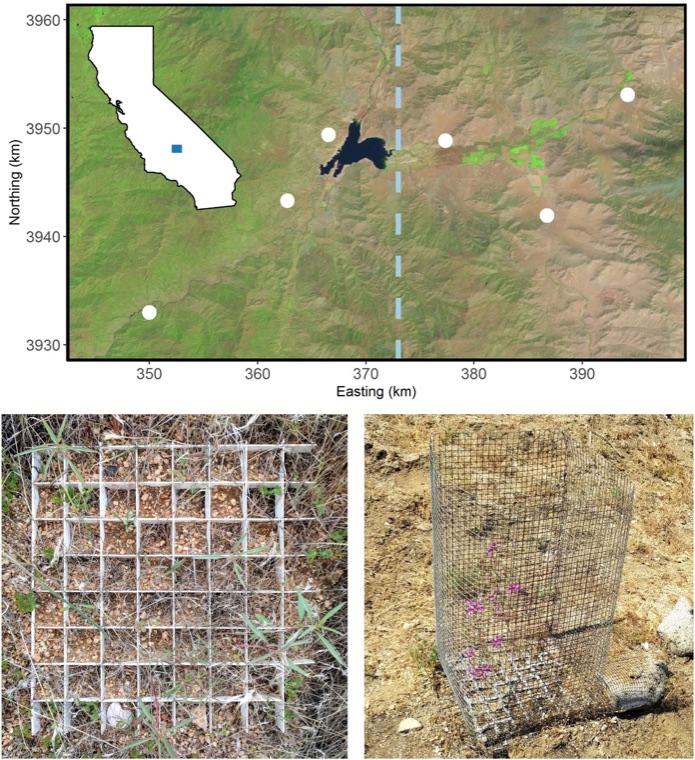
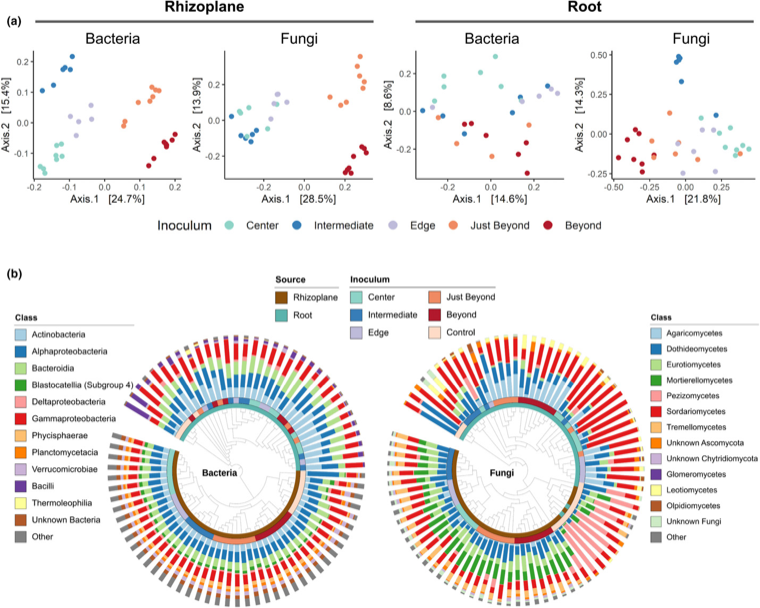
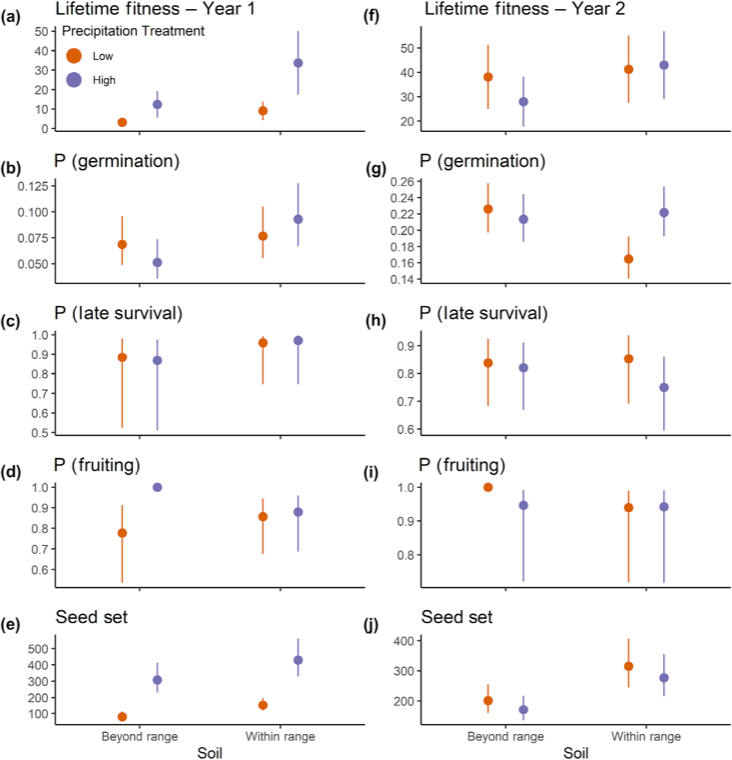
Using transplant experiments with Clarkia xantiana spanning the center, margin, and beyond-margin of its range, we tested how biotic interactions — herbivory, pollination, and mycorrhizal and soil-microbial mutualisms — combine with the abiotic environment to limit fitness and set range margins. This body of work showed that biotic interactions, not climate alone, can contribute to where a species’ range ends.
With Dave Moeller (Minnesota), Monica Geber (Cornell), and collaborators.
Key publications
Experimental range expansions in Tribolium Testing range-limit theory with replicate evolving flour-beetle landscapes
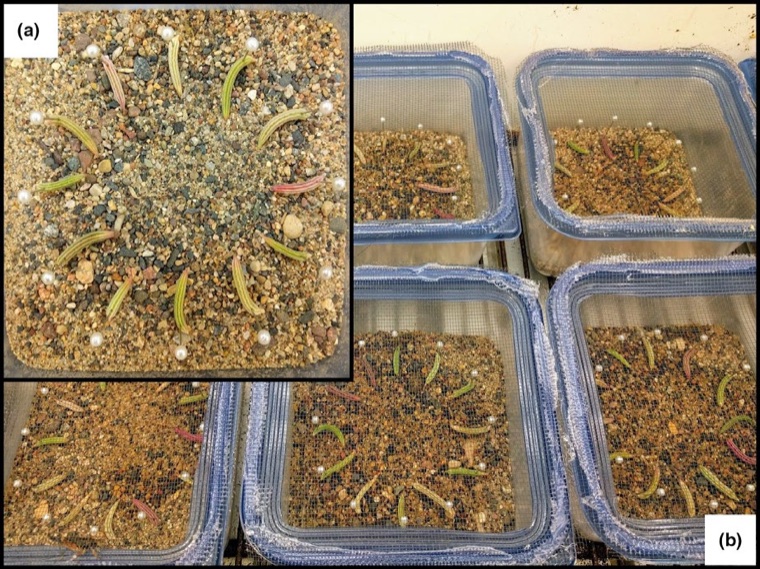
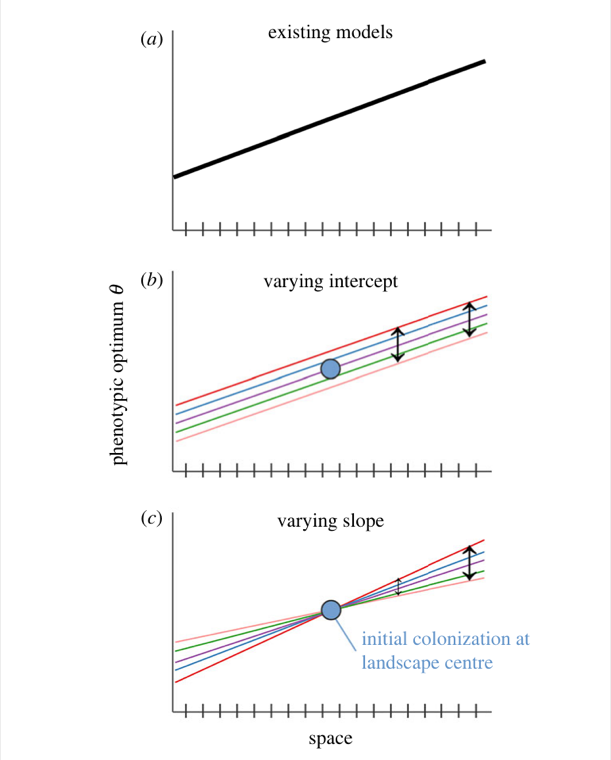
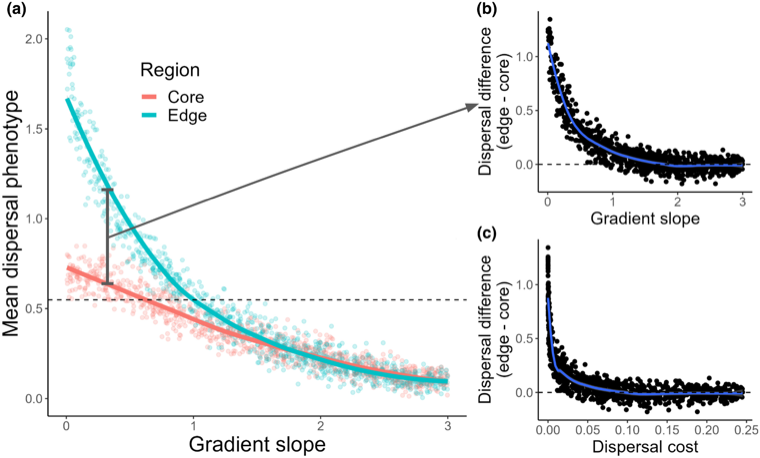
We use replicate landscapes of flour beetles (Tribolium castaneum) in the lab to test how environmental gradient shape, dispersal magnitude, and within-population genetic variation jointly govern the speed and predictability of range expansion. Whole-genome haplotagging across hundreds of beetles lets us watch the genomics of expansion in real time — including how standing variation, drift, and gene surfing shape the leading edge.
With Topher Weiss-Lehman (Wyoming). Supported by NSF DEB #2230806.
Key publications
Microbial range expansions Experimental evolution of E. coli across spatially and temporally varying environments
Using E. coli populations evolving in simulated “landscapes” — gradients in temperature, nutrients, and antibiotic pressure — we ask how environmental autocorrelation, dispersal, and demographic stochasticity interact to determine whether a population can keep up with a changing world. The system pairs experimental evolution with whole-population sequencing to track the genomics of adaptation across space and time.
Evolution during invasion in common tansy Phenotypic and genomic divergence between native and invasive Tanacetum vulgare
Common tansy (Tanacetum vulgare) is widespread across its European native range and an aggressive invader in North America. In a common-garden experiment paired with population genomics, we’re asking how the species has evolved during invasion — what traits have shifted, whether shifts are driven by adaptation versus founding-population effects, and how genomic variation in the invasive range compares to the native range.
With Ryan Briscoe Runquist and Dave Moeller (Minnesota).